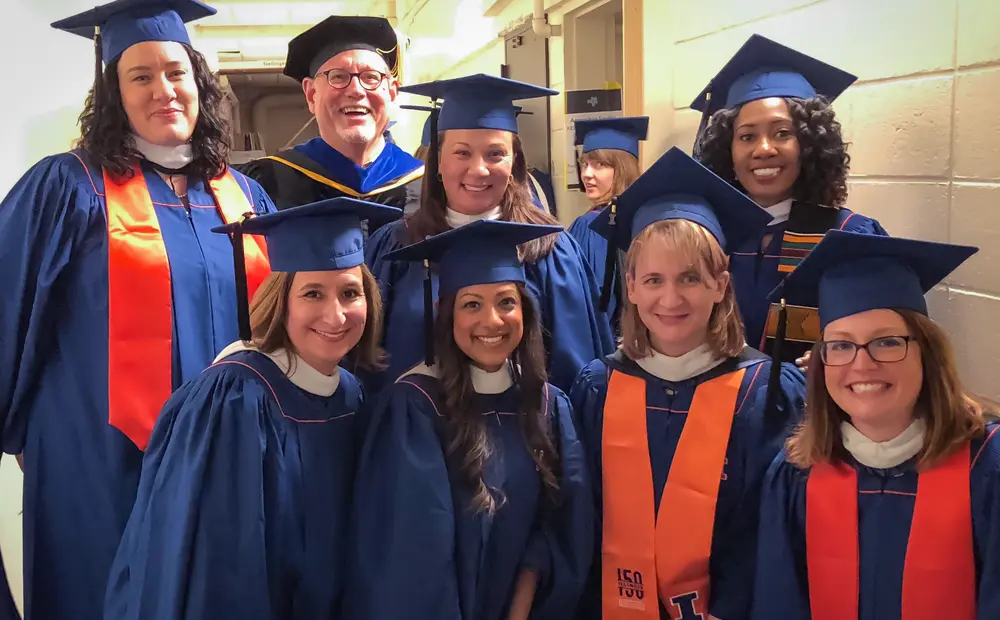
Fifteen years ago, online education was not only uncommon but often lacked credibility. Those looking for leadership roles in the health care industry often pursued master’s degrees in public health or business.
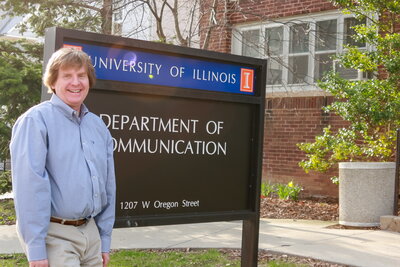
But in 2009, then-department head Dale Brashers saw an opportunity to provide those students with a high-quality distance learning program. Brashers had been considering a way to provide an advanced degree in health communication for health care professionals, but it wasn’t until the College of Liberal Arts & Sciences offered two grants for online professional degree programs that he saw a path to establish such a program — even if he considered the idea a long shot.
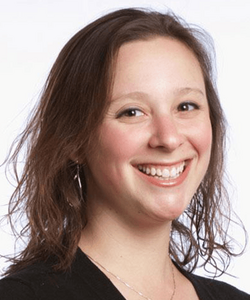
When Brashers and the department were awarded the grant, he hired Lauren Weiner, the program's current associate director, to help get the Health Communication Online Master's program up and running.
The program was set to kick off with its first cohort in Fall of 2010, but soon faced a serious setback. On July 5, just six weeks before the start of HCOM’s first semester, Brashers unexpectedly passed away.
Without the program’s visionary, it took a collaborative effort between Weiner and the Department of Communication’s faculty members to launch the program that he had cared so much about.
“Our vision [was] to provide the very best scholarship to working professionals in a way that’s affordable and accessible to them,” said communication professor John Lammers.
Lammers stepped in as the program’s director, despite not previously being involved in its development.
“He knew little about plans for HCOM outside of anecdotal discussions with Dale, but he volunteered for the job knowing how important it had been to him,” Weiner said.
The HCOM faculty also volunteered their time and efforts to get the program off the ground and teach courses for the inaugural cohort, according to Weiner.
“It was a labor of love for everyone involved — and to this day, I think that accounts for why the program is so successful.”
The challenge of an upstart distance learning program was differentiating itself from the few existing online programs by providing a real, rigorous graduate seminar, but with the flexibility that working professionals needed.
“We knew that they would need graduate education to be accommodating for their lives and professional commitments,” Weiner said.
Before Zoom was a household name, HCOM had to find a way to provide a wide variety of students within the health care industry with an experience that was on par with in-person classes while contending with the technical challenges associated with remote learning, since video calling was very high bandwidth at the time.
Without the ability for a class to meet at the same time, they needed to find the best way to engage students through asynchronous interactions. That is why the program was specifically designed to provide a high level of engagement — a way for students to interact with peers and instructors, and to apply what they learned.
“HCOM had to be more than just an in-person class put online,” Weiner explained.
HCOM accepted its first 10-person cohort in the Fall of 2010. The first few years served as a learning experience: They learned how many students were ideal for course sizes; they learned how capable and self-motivated the students were; they learned that students wanted the opportunity to network across cohorts; and they learned that multiple degree tracks were needed to better serve the diverse set of students in the program.
For the next 10 years, the program continued to grow both in size and offerings, constantly adapting to student feedback and improving teaching methods for its growing body of students. As a result, the program boasts a 95% degree completion rate and a high level of student satisfaction.
“I have never enjoyed classes like this in all my years of school,” said Elizabeth Bodunde, a current HCOM student.
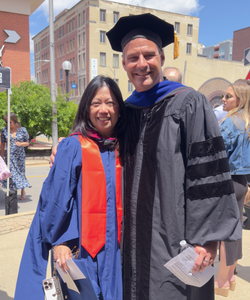
Professor Brian Quick, who is now the director, has seen how the program has evolved as one of the faculty members who helped launch it.
“I learn a lot from our students and their experiences,” Quick said. “The healthcare industry is growing, and having an MS degree allows our students the opportunity to thrive.”
According to Quick, that’s because the curriculum is led by professors who are outstanding researchers and instructors, and the courses are directly relevant to what students face in their careers. For example, when the COVID-19 pandemic hit, some HCOM students found themselves better prepared to respond and adapt.
“HCOM provided me the resources and leadership skills to confidently and soundly develop creative initiatives in alignment with improving health and well-being in our community,” Jamie Latimer (‘21) said.
When classes moved online during the pandemic, the department also leaned on the HCOM faculty’s decade of experience to help develop undergrad courses modeled after HCOM’s.
After 15 years of producing more than 200 successful alumni in a variety of fields within health care, HCOM looks a lot different than it did in 2010. Technological advances and better resources to support online programs now allow HCOM to accept students on a rolling basis, and offer one and two-year degree tracks, four different certificates for non-degree seekers, and an even more diverse curriculum, with courses ranging from visual rhetoric and health marketing to health disparities, provider-patient communication, and the future of work in health care.
Even though online programs have become much more common, HCOM continues to stand out for its intimate nature: Students in small cohorts form close connections with faculty members and peers and receive individualized mentoring and support.
“Literally every day, I would have the opportunity to engage in meaningful and interesting conversations about various facets of health communication. My classmates brought so many different perspectives and experiences to the table, and the professors were all so supportive, bringing out the best in each of us,” Liz Cohen (‘20) said.

Moving forward, the program plans to continue adapting to a changing landscape for online education and positioning a Master of Science in Health Communication as an alternative to the MPH or MBA programs often sought out by professionals looking to advance their careers.
Joanna Robson (‘25), after being offered a leadership role at a national company just months after graduating, mentioned that the hiring committee was most impressed by her HCOM degree.
Julie Ann Vera (‘22) chased her dream career at the Mayo Clinic, even though she considered it a long shot. “Before accepting the job at Mayo Clinic, I interviewed with four large health organizations and was offered two management-level positions,“ she said.
“I simply wouldn’t have a communications position at the No. 1 hospital in the country without HCOM! I apply what I learned every single day.”
Experiences like these are why HCOM hopes to reach more students at all different stages of their careers.
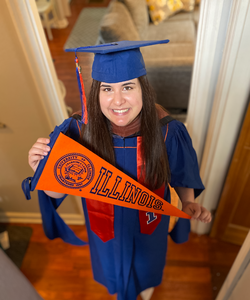
“We have seen even a few credits of HCOM coursework completely transform people’s careers,” Weiner said.
“We would love to see more students utilizing the certificate programs for Continuing Education credits, as well as professionals seeking to enter careers in health-related fields.”
While past cohorts were comprised mainly of working professionals, many students acknowledge learning things that they wish they had known when just starting out. That is why many recommend the program to students prior to entering the industry or professional programs like medical school or programs for nursing, physical therapy, or other health practices.
A decade and a half after its inception, the program has continued to innovate and improve its offerings. It empowers students to address some of the most pressing issues in all areas in health care from their first class.
“There has not been a week in this program that has not provided a learning experience I can apply to my job,” Kelly Campbell (‘21) said.
Though the program may have changed, it has always stayed faithful to Brashers’ vision.
“We all did it out of respect for Dale and to honor his legacy, and for that reason, we made it something we felt he would be proud of — and we continue to carry on that tradition today,” Weiner said.
Editor's note: This story was originally published in the Fall '25 department newsletter. For more information about the HCOM program, visit hcom.illinois.edu or sign up for one of the program’s monthly virtual info sessions.